


The Way of Work explores stories of where we fit in the world of work (without all the hustle-guru nonsense). This is part 3 of the series, How to Be Irrelevant: on creativity and identity after the hunger to be impressive wears off.
Most people think the best work is work that pays you a lot of money.
They’ll say:
“Get paid to do the thing you love!”
Well, here’s my outrageous counter-claim:
The best work is work you’d pay to do.
Wait, what?!?
Yup. I think the “best work” is not only work you’d do for free, but it is so good that you’d be willing to spend your money to do it.
I know, I know… I can already sense the eye-rolls and/or groans. But bear with me because this thought experiment may be useful to you too.
Money is good
Every so often, someone will come to me with an offer that sounds like cheating:
“We’ll pay you a lot of money for little work.”
Side note: the cruel irony of a career is you get more of these offers the less you need them.
And my first reaction is still quite primitive. I’ll think about the check. The number of commas (hopefully). I’ll think about what that check can buy. I’ll access that enormous backlog of “things to purchase,” and without much effort, find a few new things to add too. It’s so easy to envision the value money brings; the clarity is powerful enough to split the heavens.
Let me be clear: money matters. Money is good. Obviously.

But at the same time, I also know, deep down, there’s a price to be paid for that money. It’s not only what I get, but what I give: the time, stress, status, and identity at play. Money is the world’s most effective way to warp your decisions; it’s the anesthetic that covers up pain and the bribe that makes bad work look really good.
Given this same offer, you may take the money. Fine. Many times, that’s what you need to do.
But I’m willing to bet there’s a point where, no matter how good the money is, the work makes your stomach turn. I bet there’s a point where you wouldn’t sell your soul (e.g. human trafficking or investment banking). Or certain kinds of work you wouldn’t be willing to do (e.g. cleaning septic tanks or enduring the politics necessary to get your budget approved in a large co).
I know this. You know this.
But it’s never black-and-white, is it? No one ever hands you a clear this-or-that decision. Instead, it’s a whole bunch of gray. So how can you detect how much money is seducing you into the wrong decision?
Use money to invert its signal
If you really want to find the best work, you may be better off thinking about your options across a different continuum:
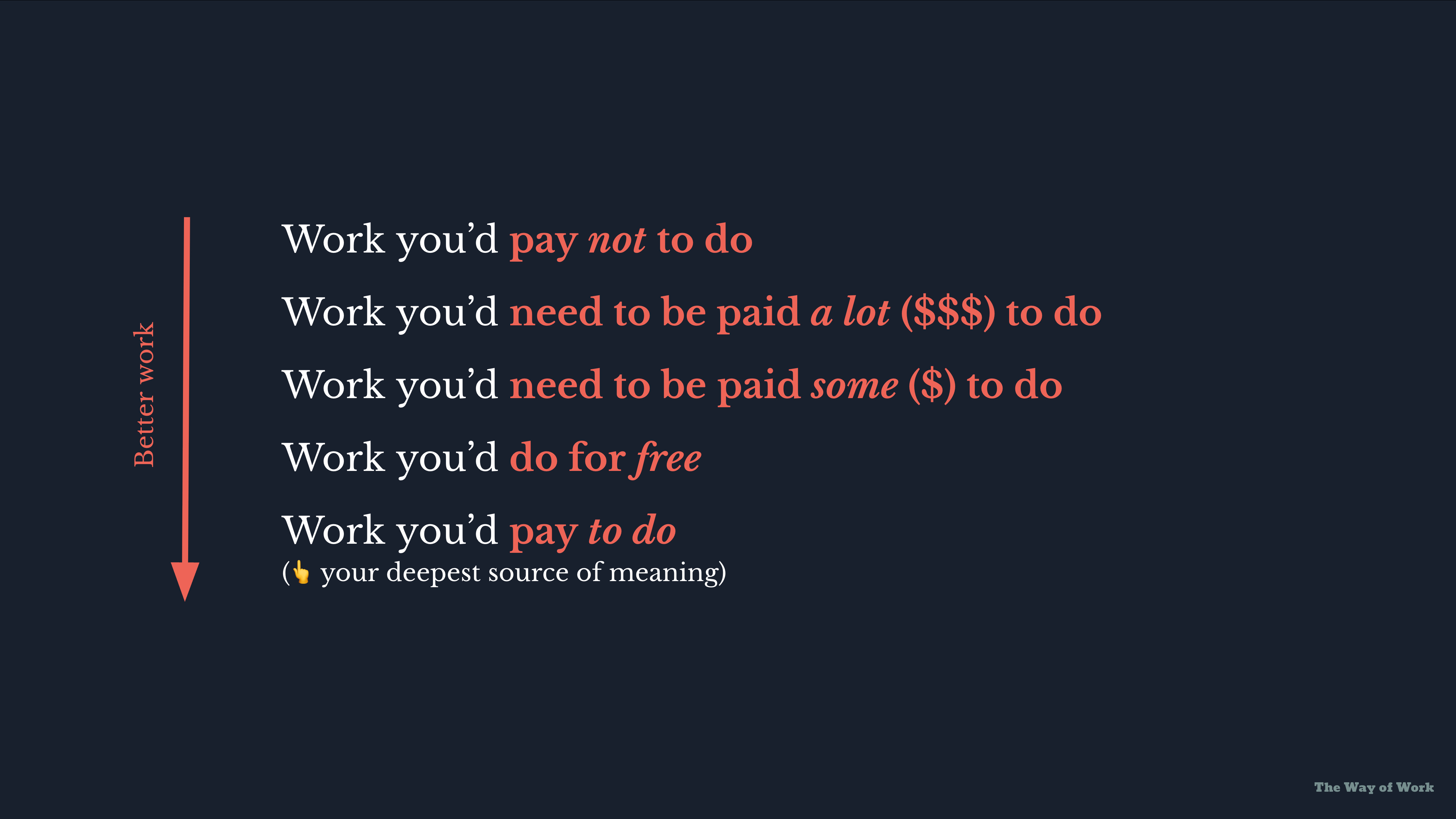
Run this test on your work (not only your full-time job, but everything around that). Ask yourself: “would I do it for free?” and even, “would I pay to do it?”
While the framework may seem absurd on the surface, it’s the ultimate clarifier. It shows what you value. It shows when you’re using hush money for your conscience or subsidizing a life you don’t respect. It may also clarify what you’re missing and need to find.
How do I know this continuum exists? Because I’ve lived through every step myself:
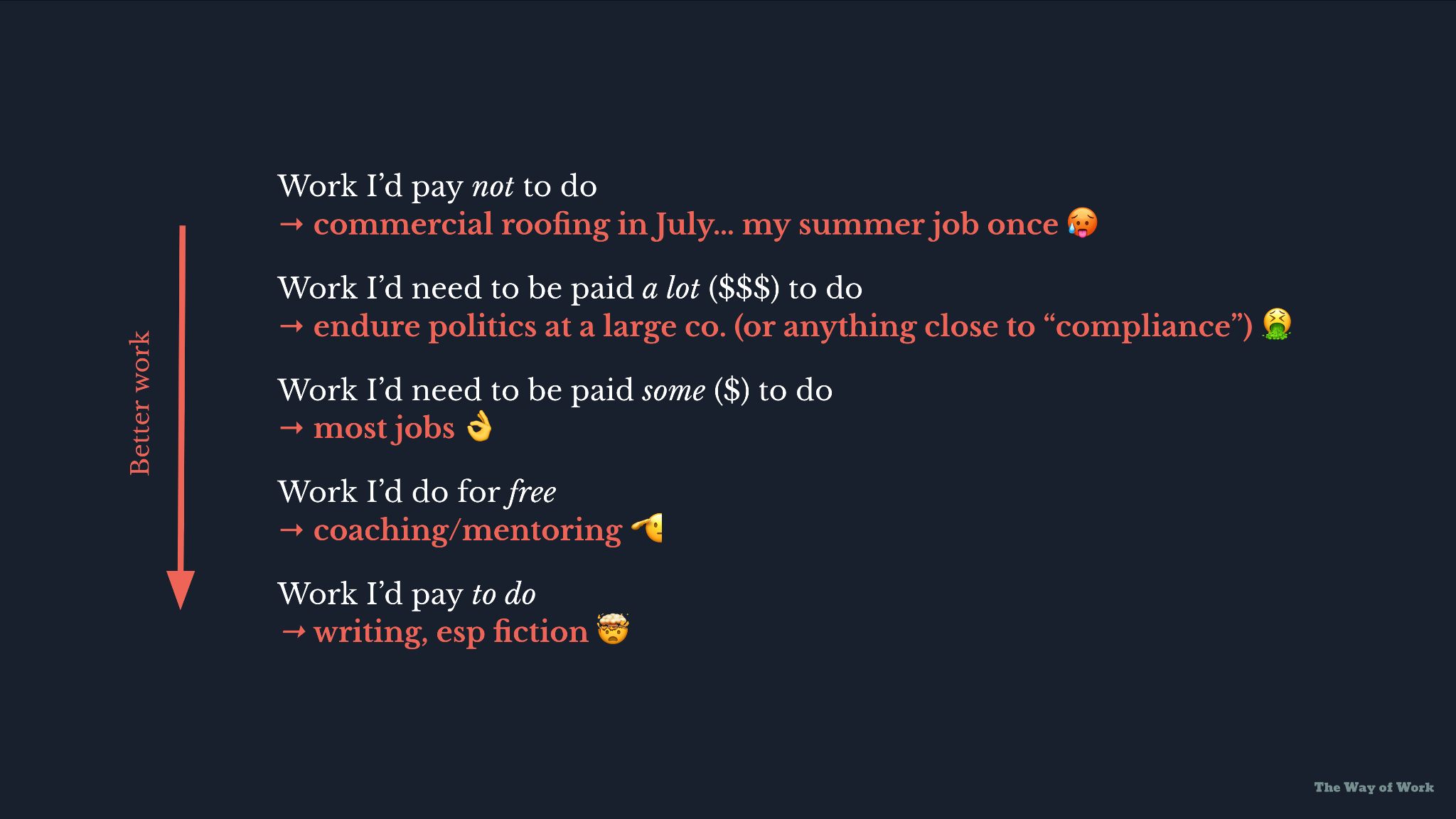
Two years ago, I didn’t know the last 2 levels on this continuum even existed. My concept of “work” was highly restrictive. Now I like writing so much that I’d do it even if it never makes me a dollar (I even expect to lose money from it). This is not meant to induce jealousy or “look at me, my life is so great!” It’s just evidence — from one former workaholic — that there are other forms of work worth taking seriously.
For the best work, you’ll have to pay
Don’t confuse this with an argument to quit your job or an argument about financial independence, as if your dreams come true as soon as you become free (I’ve written about why this isn’t true, extensively). And no, this isn’t a way to reorganize your life tomorrow.
Maybe you need the money, even if it’s not the “best work.” That’s most people. But if you can name the thing you’d pay to do, you can start moving toward it, even slowly. Or maybe you have no idea yet — in that case, keep searching.
Because if you want the best work, you will pay. Somewhere, somehow. Maybe not directly, but you’ll pay in:
Sacrificed earnings — taking less money to do something that matters more.
Flexibility — buying back time or lowering your stress so you can focus on higher-value work.
Status — stepping off the impressive track to do something that feels truer.
Comfort — choosing something harder but more important.
So no, there’s no version of “the best work” that’s free or coming to save you with a bag. Instead, find the thing you’d pay to do. That, in my opinion, is where the best work lives.
See you next time,
Rick
More from the series, How to Be Irrelevant:


Hi Rick, I'm very happy to read this thoughtful chapter of yours. I think I'm doing just that: I am paying to mentor someone to become the next generation of gardeners. I am a gardener with large property and would love to see the profession flourish in the future. I happened to meet a young woman who wants to quit her unfulfilled teaching job [too much politics] and found that gardening may give her an out. I'm paying her to help me and am teaching her the deep basis of horticulture while getting my benefit from her doing work in my garden. A win-win, I'd say.
Thank you for this framework - I took an hour to write reflections across these 5 categories of work. I was surprised that that learning and apprenticeship are major elements of what I'd look for in a "would do for free / would pay to do" category, which is a VERY useful insight as I transition to portfolio living