


The Way of Work explores stories of where we fit in the world of work (without all the hustle-guru nonsense). This is part 4 of the series, How to Be Irrelevant: on creativity and identity after the hunger to be impressive wears off.
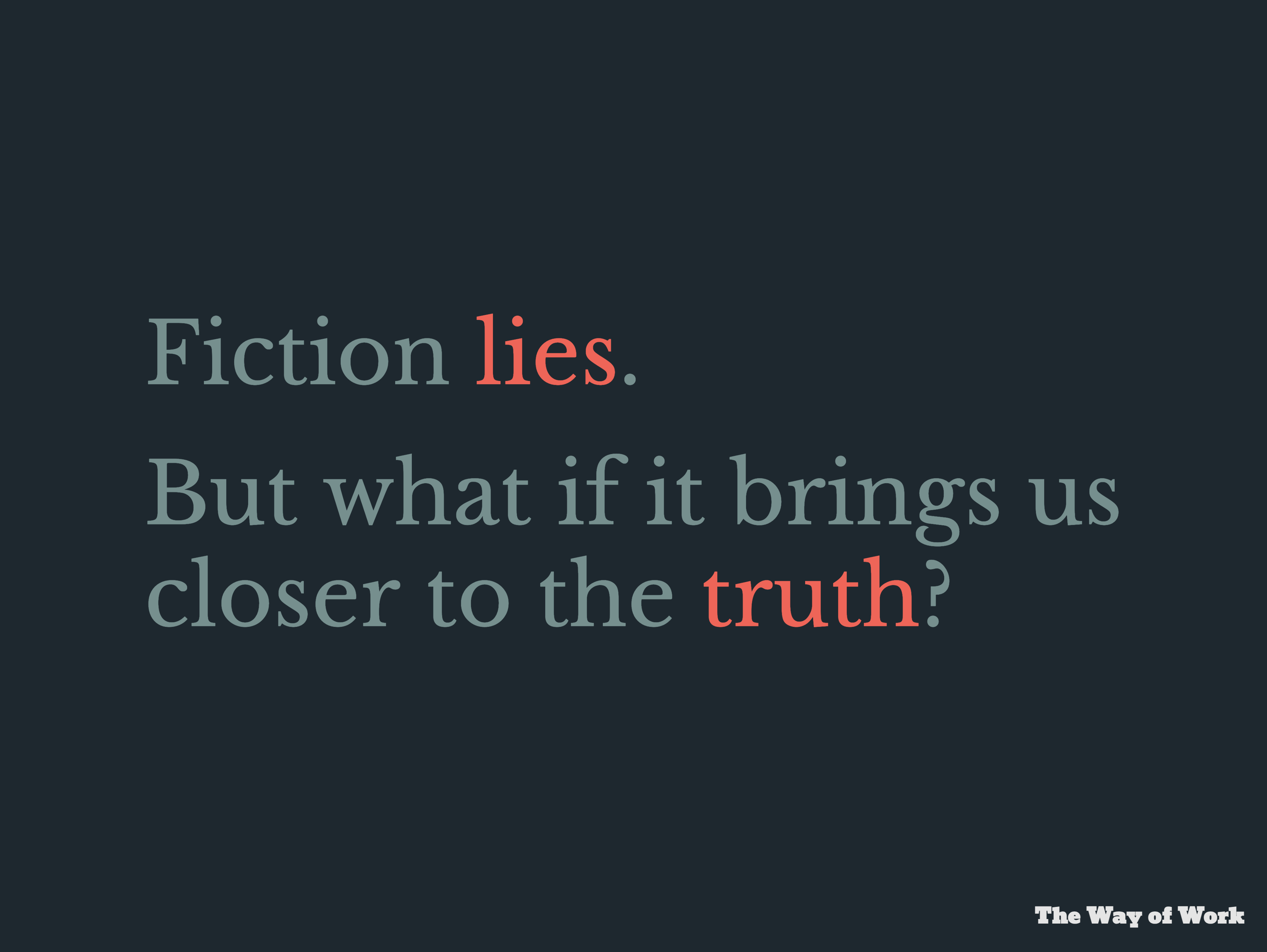
Fiction lies. But what if it brings us closer to the truth?
I remember the first time I read The Lord of the Rings. In fact, I remember exactly where I was: on the living room couch inside an old red cottage on Keuka Lake, NY. For some strange reason, I listened to a Limp Bizkit album while reading (my parents probably didn’t approve). To this day, 25+ years later, the rare times I hear any song from Limp Bizkit, like My Way, I think of The Lord of the Rings… just like Tolkien would have wanted.
The best fiction stays with you.
Then there’s The Road, by Cormac McCarthy. I remember exactly where I was for that book too: in my studio apartment in the dark basement of a building in Foggy Bottom, DC. The place had this massive picture window that looked out at dumpsters and rat traps in the alleyway. I took down the whole book in one sitting, by myself, one Sunday evening 16 years ago. I can picture the room, the lighting, everything.
Meanwhile, I have a hard time remembering my wife’s phone number.
Years later, I re-read the book after becoming a father, and woah, the story hit with a whole new punch. I remember what the dad and son found in the locked basement of that one house (if you read it, I’m sure you remember it). But most of all, I remember when they were chased and the dad pushed the gun into his little son’s hand, “Take it, he whispered. Take it.” And then, “If they find you you are going to have to do it. Do you understand? Shh. No crying. Do you hear me? You know how to do it. You put it in your mouth and point it up. Do it quick and hard. Do you understand? Stop crying. Do you understand?”
The best fiction stays with you.
Of course, it’s all make believe.
Little more than a fairy tale. Two random guys imagined some things that most of us would dismiss as crazy if they didn’t put it down in ink on a piece of paper and get a corporation to print it out. To the productive side of you? This, and all make-believe, is just a bunch of nonsense. The trivial illusions of a child. Detached from reality. No hard, practical facts or skills that make your life any better in any definitive way.
In other words: what’s the point?
No doubt, I’ve read some great non-fiction that certainly helped. Nietzsche was formative during my quarter-life crisis. Ernest Becker shaped a great deal of my worldview. Alan Watts came to me at the perfect time. More recently, The Second Mountain helped me reinvent myself after I left the corporate world (and I highly recommend that book to this crowd).
There’s something about the nonfiction frame — the implicit promise to the reader that we’re dealing with facts, real experience, actual takeaways — that makes their lessons feel more legitimate, while fiction alternatives feel indulgent, escapist, and useless.
But while the best nonfiction helps you, the best fiction stays with you.
Fiction is just way more fun, too, isn’t it?
Think of the classic philosophical thought experiment: is any of this real or are we living through a simulation? Sure, you can read what some crusty, old philosopher says about it — I’m sure some weirdos enjoy that sort of thing (hey, I’m not judging). But what about exploring this question… with AWESOME GRAVITY-DEFYING MOVES from The Matrix. “Hell yeah!” I guarantee you remember Neo dodging bullets better than you do Descartes’ theory of the thing-a-ma-jober.
Now, all this isn’t why I actually started writing fiction. The real reason is far less sexy. I’d been writing non-fiction (let’s be honest: self-help essays) for about a year and half when I started to get a bit bored. I’d tapped my available experience and wasn’t interested in dredging around the depths of my psyche to find new material.
Said simply: my life is quite boring.
And that’s totally fine! In fact, I prefer it that way. But it doesn’t exactly generate new material in the same way were I Sebastian Junger (see: What it feels like to get blown up) or you know, anyone else living a far more interesting life.
No, my reason for writing fiction had much more to do with: “I’m bored, let’s try something new.”
But it wasn’t until I really got into the story that I realized there was something bigger here. The whole process consumed me. The flow states hit harder than a Limp Bizkit song. Daily, the story pulled me under in a way I’d not experienced before, maybe in a way that some might call, dare I say, a “calling” (a word I try to stay away from).
More unexpectedly, through creating a story, I was also able to hit new ground. There’s something special about fiction, as both the writer and the reader, that allows us to access places deeper than we ever thought we could go. You can go there — wherever “there” might be. While non-fiction deals with the truth, it’s fiction that can sometimes get closer to the truth by not being constrained by it.
How so? Well, in my essays here, I don’t flinch away from topics like meaning, identity, or ambition, and I revel in the chance to poke at conventional wisdom. But what about the stuff underneath that? The stuff that even I don’t want to say out loud?
What about my fear of death? Not the abstract philosophical kind, but the specific, visceral fear that I will leave my kids before I’m ready or they’re ready? That one day they’ll become adults with lives of their own, and whatever I was to them will slowly blur, and then I’ll be gone. And soon after, they’ll be gone too. And the memory of me, of them, will be erased, like chalk washed off in the rain, vanished as if never here, slipped quietly into the eternal empire of the forgotten.
Sorry, but nonfiction doesn’t cut it here.
And I bet you can name a story that hit you in a way that no accurate, practical, grounded nonfiction book ever could.
The best fiction stays with you.
Now, I’m not claiming that my debut novel will come out of the gate and shock the world. It probably won’t be considered “the best fiction ever” (though if you were to say that, I wouldn’t stop you; and it’s not like I’m gonna decline the Pulitzer). And when I consider all the time I spent writing fiction, compared to the thousands upon thousands of people who’ve read my nonfiction writing, it’s likely that far less people ever read my book.
Also, my novel could flop, and I could be accused of adding to the slop. I could torch my hard earned reputation, which I increasingly seem desperate to light on fire. Or worse, no one will care… forgotten even before I’m gone.
After all, art’s most likely outcome is irrelevance.
Even still, there’s something, something special about fiction that, in the end, is worth the try. Maybe some day, one kid, a punk like I was, will pick up my story and feel something he hasn’t felt before. It’s not likely, but it’s possible. It’s possible I’ll help him access something he couldn’t have found on his own. Maybe it’s a stranger. Maybe it’s one of my own.
I won’t be able to explain things to him with a perfectly logical argument delivered through an old, forgotten newsletter post. No, the topic’s too deep and the essay would be way too boring. Instead, it can only be accessed through this story that I’ve created. One that isn’t real, that isn’t my own story, but also, really is my story.
And years later, after he tastes success but it feels flimsy, after he’s exhausted every bit of self-help advice he can handle, after his ambition runs dry, then maybe, just maybe, like me, he’ll too decide to give fiction a try.
See you next time,
Rick
More from the series, How to Be Irrelevant:


Hmm, this is really interesting to think about Rick. I too feel like I’ve reached a bit of a dead end with my non-fiction writing (though to call it “self-help” … ooh, that hurts!), but I wonder if there would be a way to explore the deep issues I’m interested in via fiction. I’m gonna go off and ponder that one.
It's wild to consider the sheer depths an author can go to when exploring their own world through the fiction they craft. Especially if authoring multiple books over a long, storied career as a creator.
Quite lovely that in some ways, it might be the single most sustainable way to do one's personal self-help work.