



The Way of Work explores stories of where we fit in the world of work. This is part of the series, Existential Explorer: ideas from the edge of the map.
The Man in the Red Convertible
We mock the Midlife Crisis, but you may want to have one.
The “Midlife Crisis” automatically conjures up the picture of a middle-aged man, probably with a gut, wearing a shirt with too many buttons undone at the top, sitting inside a red convertible (leased, not owned), the strands of hair on a balding head flowing in the breeze.
Pathetic, right? Chasing status he’ll never have, youth that won’t return, approval he’ll never receive.
His dreams are dying. But they hang on for dear life in his head, unable to accept that certain roads may be closed for good.
Maybe he buys a leather jacket. Gets some Botox. Looks for a young fling to prove he’s still got it. Books a spiritual retreat to reinvent himself over a long weekend. Or maybe he just needs to start a newsletter. Some symbol to reaffirm that he still matters.1
Because the bills keep coming. The children are relentless. Obligations, endless. His marriage dulled down to the logistics. Hobbies? What are those? Life turned out to be harder, and way more boring, than he thought it would be.
Didn’t he do all the right things? Met life’s demands, strove for what he was supposed to? But the life he’s built, filled with nice things and important-sounding titles, all things he thought he wanted, now feels like a cage. Regretfully, it’s one he made himself. Inconveniently, it’s not one he can easily escape.
He may fantasize about running off to a cabin in the woods. Maybe even an apocalypse… something, please, to help clear a few things off his calendar.
And as if things weren’t bad enough, death is within view. He sees it in his aging parents. But no place more than the mirror: the accumulating midsection, the receding hairline, wrinkles around the eyes, aches all over. He’ll listen to one Huberman podcast, start binging on strange supplements, and sign up for a 10K (his knees, in no way are ready).
His life? Feels like a whole lotta nothing. One step after another, on the way to nowhere profound. His memory? Will be lost in the abyss of history. Forgotten even before he’s gone.
“I think I know him better than anyone here. This is a quiet, frightened, insignificant man who has been nothing all his life, who has never had recognition, his name in the newspapers. Nobody knows him, nobody quotes him, nobody seeks his advice... That’s a very sad thing, to be nothing.” – Juror #9, from 12 Angry Men
But underneath it all, there’s something else: the genuine opportunity for reinvention.
Maybe it’s not too late.
Crashing the Car
A few years ago, I accelerated myself into a midlife crisis by stepping away from a secure identity into the unknown. Crashed the car on purpose, it may seem.
I was told that at 38 I wasn't midlife enough to have a midlife crisis. Well, I’ve always been a bit advanced for my age 😏 — an old fart at heart.
Don’t worry, I’m not going to rehash my story again; you’re welcome to read about my rise and fall elsewhere. But here’s some new information: I contemplated starting a “midlife healthcare company” that was focused on the unique challenges of men and women in this life-stage. We’ve got pediatrics and geriatrics, then not much in between. The hope was you could exit midlife better off than you entered.
If you need the summary: midlife is a bitch. It’s more of a midlife crunch where pressure comes from all sides: work, money, health, family. You’re juggling needy kids and aging parents. Too many hours to pay off a crippling mortgage. Less energy despite more to do. It’s when you’re more at risk for deaths of despair (e.g. suicide, alcoholism, drug-overdoses), depression, and heart issues. Famously, this was synthesized into the “U-shaped curve of happiness,” where life bottoms out at 47.2 years old. Even apes, it turns out, show signs of midlife slumps.
For those of us in or approaching midlife… “FUCK!!!”
What may once have been thought of as a period of thriving – career on track, family coming together, secure in our identity, etc. – turns out to be a couple decades of doom.
But, as I’ve learned, the crisis of midlife is an opportunity for renewal. A fresh start before it’s too late. The unhappiness, overwhelm, and oncoming decline are shoves to step back and ask:
“What have I done with my life?”
“What have I been avoiding?”
“What do I want with the time I have left?
These can be viewed as big, scary questions… OR necessary ones to explore before it’s too late. The crisis, if you’re lucky enough to feel it, forces you to stop.
Maybe it’s your health. Face it, you’re aging and things don’t get automagically better from here. But this is an opportunity, not to live forever, but to live well while it lasts.
Maybe it’s your peace. It’s time to stop pretending stress is the price of success. That if you keep going like this, your body might quit before you do.
Maybe it’s your relationships. The half-attention you bring to your partner. The way your kids are growing up in front of you, yet you’re still distracted. A chance to not just physically be there, but mentally present.
Maybe it’s your ambition. Good job, you’ve played the game well thus far. But now it’s time to build your own ladder, instead of climbing someone else’s. It’s time to clarify what success means to you, not someone else.
Maybe it’s time to start again. Not to reinvent yourself into something impressive, but into something more alive. More human. Shedding the inherited structures, the masks you put on, to rebuild your own.
Sometimes we need a crisis, something greater than the quiet hum of dissatisfaction, to make a change. “Creative destruction,” a period where old assumptions fall apart to make room for something new. It’s a necessary rebellion against outdated versions of ourselves. Ashley Kelsch recently said it well:

Sure, our choices are more narrow now. We have less energy and more reason for caution. But that also brings clarity. There’s little time left and fewer lies we can afford to tell ourselves. A healthy sense of urgency seems like a wise move — this, right now, may be our last time.
Instead of starting that company, I chose the reckoning within. I refused to continue heads down, only to awake one day and wonder what I may have missed. I didn’t want my future to be a dull extension of my past.
Yeah, it sucked. I felt a special kind of fear, which I can only describe as a black hole in my chest. A vertigo that comes from standing at the edge of the void, only to realize the void is inside you. It’s one that shows up when you start asking yourself questions you’re not sure you want the answers to. Fun ones like: “What if I am nobody?”
Yikes.
And yet, somehow, that was still better than pretending everything was fine as is.
Instead of seeing it as a midlife crisis, I tried to reframe it as a “midlife reset.” Not a grand hero’s journey anyone will make a movie about, just a quiet rite of passage. A chance to reconcile my past and recommit to what mattered.
That old saying, “never let a good crisis go to waste”2 can flip the midlife malaise from something to avoid, to something to need.
Off Cruise Control
Let’s get back to our middle-aged main character…
Maybe he looks in the mirror and decides it’s time to change. He’ll never be ripped, but he starts adding back healthy habits, one-by-one (a little Botox couldn’t hurt either, right?). And he wisely skips the young-thing fling and decides to revitalize his relationship with his wife instead.
He picks up a hobby. It’s the guitar. Yeah, super cheesy, I know. But who the hell cares? Maybe he does start that newsletter (read it for christ’s sake!), content with a tiny following that will never make him a living, but allows him to explore ideas and meet interesting people.
He’s grateful for his success so far, but decides to define it for himself going forward. There are other mountains he feels he’s meant to summit. Maybe he doesn’t need to blow up his career, but he can make edits to make it more meaningful. He won’t work with assholes anymore (and tries to not be one). He accepts some drudgery, but inches further toward projects that interest him. Give back more, not just extract more. At midlife, he may have less time, but he has more leverage.
He reconnects with a few childhood friends and joins a new community. It’s a group of men his age who also like convertibles. Go figure! Maybe contentment can even be found in the cliché.
But the biggest shift is when he realizes there’s a layer beyond the tactical and practical edits. Beneath the surface-level momentum. It touches the ambient fear that, as he declines, the guitars and cars won’t save him from nothingness. That all this activity, switching from this to that, is still a mask.
And in embracing that void, something unexpected happens: he creates space to allow something new in. Call it “spirituality” or whatever you want. It’s a path he’s bulldozed over in the past. Maybe it’ll lead to nowhere. But it feels like an opening to something beyond himself. Where, for the first time, he may finally glimpse what really matters.
I’m not saying our main character pulls it all off. He’s unlikely to flip from pathetic to perfection overnight. But improvement could happen. That’s what the crisis offers: the catalyst for change while we still can.
When it comes to the “Midlife Crisis,” the real problem may be never having one at all. Postponing the dread with dull comforts. Quelling the unease with quick fixes. Until later, when there’s no time left.
Maybe it’s not too late. Not fixed, but now awake. And that might be enough.
⍰ Question: Have you had a midlife crisis? In what ways did it change you?
📚 Further Exploration: For those curious enough to continue the exploration…
what does it mean to shed your masks at 40. the jung theory., credit Michael Karnjanaprakorn for sharing
The Seasons of a Man’s Life, by Brett and Kate McKay
Why men shouldn’t fear being “middle aged”, with Khe Hy and greg scheinman3
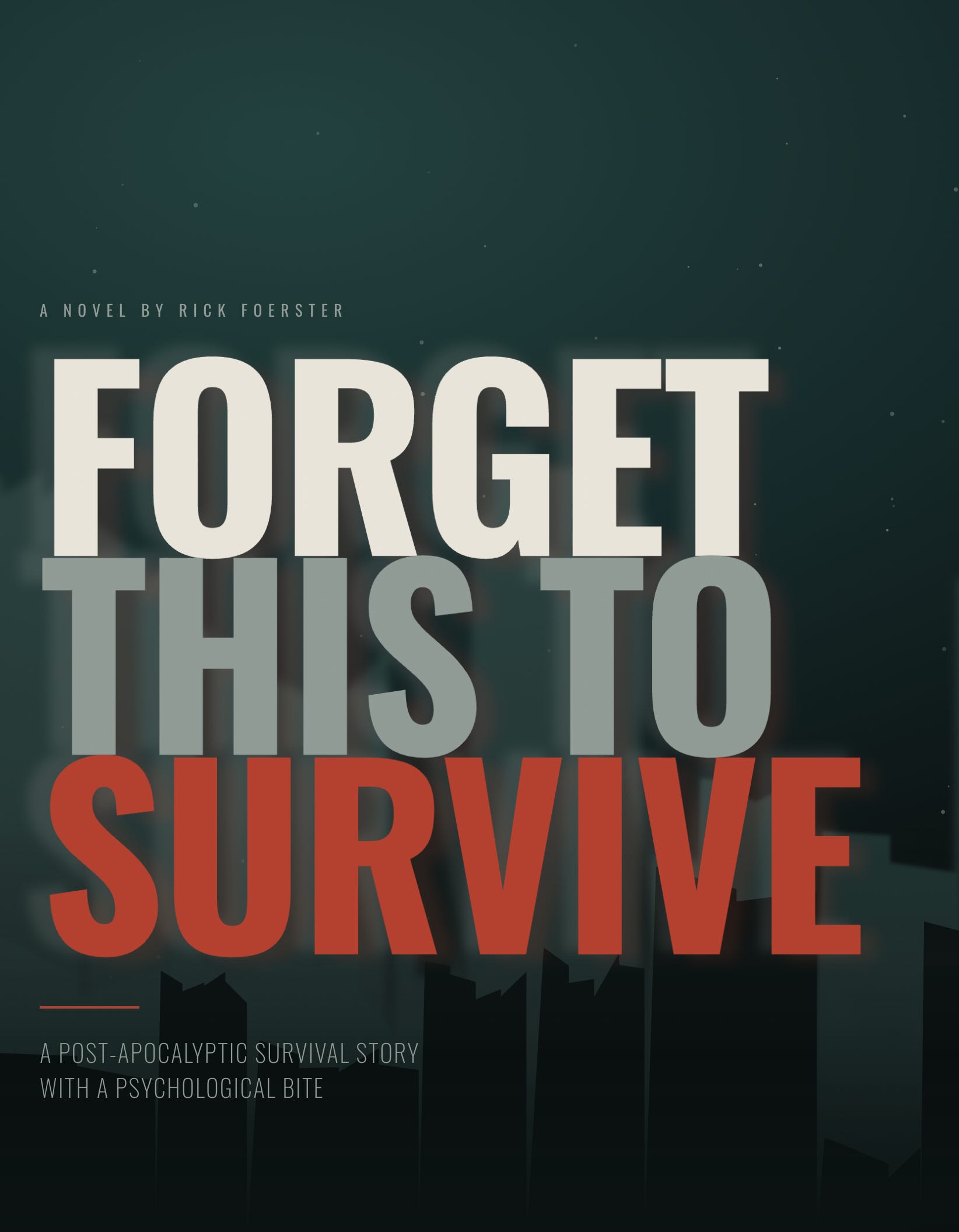
Big news: My debut novel, FORGET THIS TO SURVIVE, is officially coming Spring 2027.
“Holy crap… a serious page turner.” - Noah
It’s a dark, pulse-pounding post-apocalyptic thriller about the psychological cost of survival - and the lies we need to keep going. Fans of The Last of Us, Silo, and Chaos Walking will feel at home.
More from the series, Existential Explorer:


Right around here, my wife wanted to make sure I clarified that this man is a fictional character and not me!
Often attributed to Winston Churchill.
Some of these resources may be “men” oriented (I am one, after all), but hopefully they are helpful to everyone.
Thanks everyone, for reading! I am curious to hear, for anyone who has a "Midlife Crisis" (or like it) before, how did it affect you? Was the result a net positive or negative?
P.S. I also created an addendum of "5 specific ways I got through my own Midlife Crisis" that people seem to find helpful:
https://substack.com/@rickfoerster/note/c-116773073?utm_source=notes-share-action&r=3uceyo
Great piece! A few thoughts I had around this topic, just throwing them in. I think the whole midlife crisis term could get a reframe if we normalized that life is a continuous reinvention of oneself and that usually comes with some hard work at the beginning. Also probably the ‚default path‘ story plays its role that it happens in such a scale - so many find themselves on paths not made for them and hopefully the big awakening comes at some stage! I think the thirties is where for most people everything comes together and life just gets so overwhelming, forcing some to stop and rethink. Can we not design life differently so that not all factors hit in the same ten years?
Funnily, also all the default path milestones get reached until in your thirties. And then? You‘re out of a blueprint if you’re on it.